
 In the world of heavy machinery, profit margins are often razor-thin. Whether you are managing a fleet of used excavators or brand-new wheel loaders, the single largest variable expense after the initial purchase price is almost always fuel. For decades, operators have been taught that moving dirt faster means moving money faster. However, this mentality often leads to a catastrophic waste of diesel.
The truth is, the difference between a profitable job site and a break-even one often comes down to micro-adjustments in operator behavior—specifically, how the throttle is managed.
Most operators treat the throttle like an on/off switch. They slam it to maximum RPM the moment they start the engine and keep it there until the lunch bell rings. But what if I told you that by learning a simple, physics-based throttle modulation technique, you could reduce your fuel consumption by 10% to 20% without sacrificing productivity? This isn’t about driving slower; it’s about driving smarter.
In this guide, we will dissect the relationship between engine RPM, hydraulic flow, and torque. We will explore a technique known as “throttle feathering” or “load-sensing management.” Whether you are operating brand-new Tier 4 Final equipment or maintaining a yard full of used excavators, this guide will help you turn your machine into a fuel-sipping asset rather than a fuel-guzzling liability.
Chapter 1: Understanding the Hydraulic Dialogue
Before we can master throttle control, we must understand what happens when you press the pedal or move the joysticks.
Modern excavators and heavy machinery operate on a simple principle: the engine provides power to a hydraulic pump, which in turn sends fluid to the cylinders and motors that move the machine. However, the relationship between engine speed (RPM) and hydraulic efficiency is not linear.
Many operators believe that if they run the engine at 2,200 RPM, the hydraulic system moves 100% faster than at 1,100 RPM. This is a myth. In reality, the speed of your hydraulic actuators (the arm, bucket, and swing) increases, but the force (breakout torque) remains largely the same once the engine meets the pump’s pressure requirements.
When you run a machine at full throttle, you are creating a surplus of hydraulic flow. This surplus is converted into heat. Heat is the enemy of hydraulic systems. It degrades seals, thins out hydraulic fluid, and wastes fuel.
The “Sweet Spot” Theory
Every machine has a “sweet spot”—a specific RPM range where the engine produces peak torque without excessive RPM. For most used excavators from brands like Caterpillar, Komatsu, or Hitachi, this sweet spot is typically between 1,300 and 1,600 RPM. In this range, the hydraulic pump is moving enough fluid to perform 95% of standard digging tasks, but the engine is burning significantly less fuel than it would at 2,000+ RPM.
The goal of our technique is to keep the machine in this sweet spot during non-peak load cycles.
Chapter 2: The “Feathering” Technique Explained
The “Feathering” technique is a dynamic throttle management strategy. Instead of setting a fixed RPM via the hand throttle (dial) and leaving it, you use the foot throttle (if available) or adjust the dial constantly based on the load demand of the task.
Step 1: The Warm-Up Phase
Never start a cold diesel engine and rev it to high RPM. When working with used excavators, which may have slightly looser tolerances than brand-new models, cold revving can cause accelerated wear.
-
Technique: Start the engine. Set the throttle to low idle (approximately 800–900 RPM). Allow the engine to run for 3–5 minutes to circulate oil. Then, increase the RPM to 1,200 for another 3 minutes. Do not touch the hydraulics until the temperature gauge begins to move.
Step 2: The Idle/Engage Strategy
When performing repetitive cycles—such as loading trucks or trenching—operators often leave the RPM high while waiting for the next truck to arrive.
-
Technique: When you anticipate a pause longer than 10 seconds, reduce the throttle to low idle. A common myth is that idling saves fuel. While it saves more than high-idling, idling still burns roughly 0.5 to 1.5 gallons per hour depending on the machine size. By combining low idle with feathering, you maximize savings.
Step 3: The Load-Matching Principle
This is the core of the trick. When you begin a dig, you do not need full RPM until the bucket is actually in the ground and encountering resistance.
-
Technique: Approach the pile or the trench wall at 1,300 RPM. As you start to crowd the bucket (stick out) and begin the curl, then increase the throttle.
-
Why it works: Hydraulic systems rely on pressure to dig, not just flow. Pressure builds up only when there is resistance. By delaying the high RPM until the moment of peak resistance (the curl and lift), you avoid wasting fuel during the “dead” movement of the arm swinging to the pile.
Chapter 3: The Science of Torque vs. Horsepower
To truly appreciate this technique, one must understand the torque curve of a diesel engine.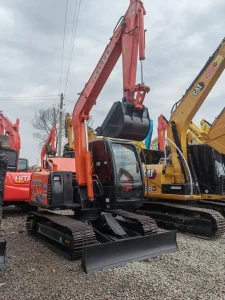
Diesel engines used in Other machinery such as wheel loaders, dozers, and graders are designed to produce maximum torque at lower RPMs. Torque is what moves the machine and breaks the ground. Horsepower is merely a function of torque multiplied by RPM.
If you operate at 2,200 RPM, you are producing high horsepower but only slightly more torque than at 1,400 RPM. The extra RPM is simply spinning the hydraulic pump faster, forcing oil through the system at a velocity that often exceeds the actuator’s ability to use it. This results in “hydraulic stall” or pressure relief valves opening, which literally turns diesel fuel into waste heat.
By keeping the RPM at the torque peak (typically 1,400–1,600 RPM) during the digging phase, you utilize the engine’s natural efficiency. The engine is working hard—optimal combustion occurs under load—but it isn’t over-revving.
Chapter 4: Practical Application on Used Excavators
Let’s focus specifically on used excavators. When a machine ages, its hydraulic system may develop micro-leaks or the pump efficiency may drop slightly. Operators often compensate for this by increasing the RPM to “force” the machine to move faster. This is a mistake.
If you own or operate used excavators, consider this: a 20-ton excavator running at full throttle (2,200 RPM) consumes approximately 4–5 gallons per hour. Running that same machine at 1,500 RPM consumes approximately 2.5–3 gallons per hour.
The Cycle Test:
Take a stopwatch and time a standard cycle: Dig, swing, dump, swing back.
-
At Full Throttle (2,200 RPM): Cycle time = 18 seconds.
-
At Feathering Technique (1,500 RPM, throttle up during curl): Cycle time = 20 seconds.
You lost 2 seconds per cycle. If you are doing 100 cycles an hour, you lost 200 seconds (roughly 3 minutes) of productivity. However, you saved 1.5 gallons of fuel.
At $4.00 per gallon, that’s $6.00 saved per hour.
If the machine works 2,000 hours a year, that is $12,000 saved.
Is that 3 minutes of lost productivity per hour worth $12,000? Usually, yes.
Moreover, on used excavators, lower RPM reduces stress on the swing bearing, final drives, and hydraulic hoses. You aren’t just saving fuel; you are extending the lifespan of the machine.
Chapter 5: Extending the Technique to Other Machinery
While we focus heavily on excavators, this principle applies universally to Other machinery on the job site.
Wheel Loaders:
Wheel loaders often use torque converters. The “Kickdown” technique is essential. Instead of flooring the throttle when approaching a pile, operators should approach at a moderate RPM, let the bucket make contact, then apply throttle. This prevents tire spin and converter overheating. Using the “variable throttle” approach in a wheel loader can reduce fuel consumption by up to 15% in load-and-carry applications.
Dozers and Graders:
For dozers, the “slot dozing” technique combined with throttle management is key. When pushing a load, the blade fills quickly. Once the tracks begin to slip or the engine load peaks, increasing RPM does not increase pushing power; it just increases track slip. Instead, maintain a steady RPM and let the machine’s weight and undercarriage do the work.
Skid Steers:
In compact machinery, operators tend to rev to maximum RPM immediately. Because these machines often use hydrostatic drives, high RPM leads to high heat. Feathering the throttle while engaging the drive motors and hydraulics simultaneously can drastically reduce fuel burn and hydraulic oil temperatures.
Chapter 6: The Role of Eco-Modes and Telematics
Modern machinery—and even some well-maintained used excavators equipped with aftermarket telematics—comes with “Eco” modes. However, many operators disable Eco mode because they feel it “slows them down.”
The truth is, Eco modes are simply automated versions of the throttle feathering technique. They cap the maximum RPM and optimize the pump’s absorption of engine power.
If you are resistant to using the foot throttle dynamically, simply engaging the Eco mode on your machine can yield 5–10% fuel savings immediately. But to achieve the 15–20% savings discussed in this article, you must combine Eco mode with active throttle modulation.
Chapter 7: Common Myths Debunked
To fully embrace this technique, we must clear up some deeply ingrained misconceptions.
Myth 1: “High RPM makes the hydraulics stronger.”
-
Reality: Hydraulic strength (force) is determined by the pressure relief valve setting, not the engine RPM. A machine at 1,300 RPM has the same breakout force as at 2,200 RPM. The only difference is the speed of the hydraulic movements.
Myth 2: “Idling is free.”
-
Reality: Idling is not free. For used excavators, idling also causes “wet stacking” (unburned fuel accumulating in the exhaust), which damages the diesel particulate filter (DPF) or clogs the exhaust system. If you are idling for more than 5 minutes, shut the machine off.
Myth 3: “Feathering wears out the throttle pedal.”
-
Reality: Modern electronic throttle pedals are robust. They are designed for millions of cycles. The wear you are preventing in the engine and hydraulics far outweighs the negligible wear on a pedal sensor.
Chapter 8: Step-by-Step Operator Training Guide
If you are a fleet manager, you cannot simply tell operators to “save fuel.” You need to train them. Here is a script to use for training on Other machinery and excavators.
-
The Baseline: Show the operator the current fuel consumption screen (if equipped) or calculate the burn rate. Explain the cost per hour.
-
The Sound Exercise: Have the operator close the cab door and listen to the engine. At full throttle, the engine screams. At 1,500 RPM, it purrs. Tell them: “If you can hear the engine roaring, you are burning money unnecessarily.”
-
The Joystick Feel: Have them dig at full throttle. Then, lower the throttle to 1,400 RPM. Ask them to curl the bucket. They will notice the bucket curls slightly slower, but the force is the same. Explain that they can “pre-throttle” with their left foot or hand as they curl to match speed only when needed.
-
The Delay Rule: Implement a rule: “When the bucket leaves the ground, the throttle comes down.” As the machine swings from the pile to the truck, you do not need maximum RPM. Reduce throttle during the swing. Increase it again just before dumping if needed for lift.
Chapter 9: Economic Impact Over a Year
Let’s crunch the numbers for a medium-sized fleet.
Assume you have five used excavators and three units of Other machinery (e.g., wheel loaders and dozers).
-
Average machine size: 25-ton class.
-
Average baseline consumption (poor throttle management): 4.5 GPH (gallons per hour).
-
Average consumption (feathering technique): 3.5 GPH.
-
Savings: 1.0 GPH per machine.
-
Annual hours per machine: 1,800.
-
Fuel cost: $4.00/gal.
Annual Savings per Machine:
1 GPH x 1,800 hours = 1,800 gallons saved.
1,800 gallons x $4.00 = $7,200 per machine.
Total Fleet Savings:
8 machines x $7,200 = $57,600 per year.
This $57,600 is pure profit. It does not account for the reduced maintenance costs—less frequent oil changes, less wear on undercarriages (due to lower travel speeds), and fewer hydraulic repairs.
Conclusion
The secret to saving thousands of dollars in fuel annually is not found in a new gadget or a high-tech retrofit. It is found in the operator’s seat.
The simple act of matching engine RPM to the load demand—feathering the throttle up during peak resistance and back down during idle movements—transforms a machine from a fuel waster into a profit center. Whether you are dealing with a brand-new, GPS-guided robotic machine or a fleet of aging used excavators, the physics remain the same: torque does the work, RPM wastes the fuel.
By training your team to listen to the engine, to feel the hydraulics, and to respect the torque curve, you will see immediate results in your fuel receipts. You will also see long-term results in reduced maintenance costs, longer component life, and a safer, quieter job site.
The era of “wide open throttle” is over. In today’s competitive construction and excavation industry, efficiency is the ultimate competitive advantage. Start feathering today, and watch your bottom line improve with every tank of diesel.